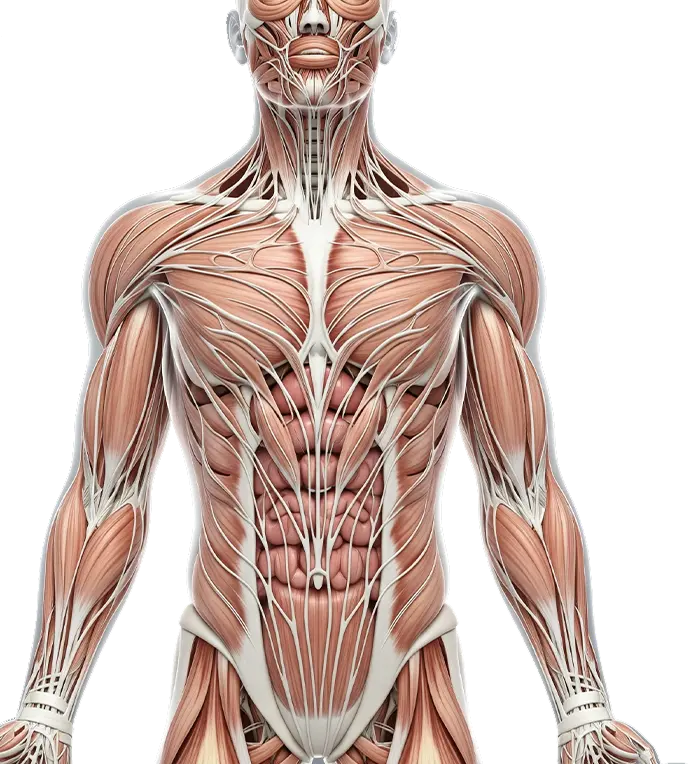
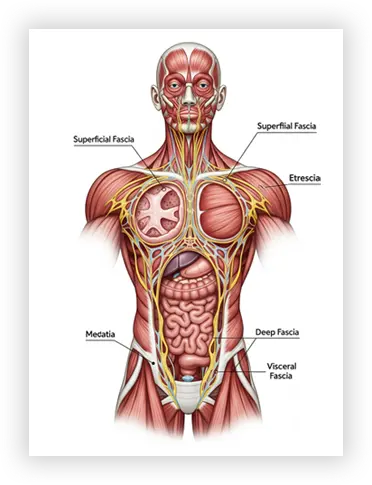
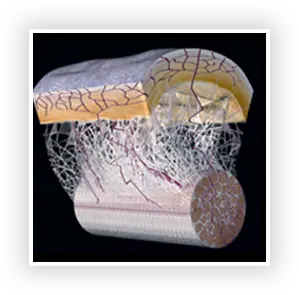
1. The myofascial system is a connective web of tissue that runs throughout the entire body.
Study summary
Researchers reviewing fascia describe it as a continuous three-dimensional connective tissue network that surrounds muscles, bones, nerves, and organs, transmitting mechanical forces and linking structures across the body rather than functioning as isolated tissue layers.
Citation
Wilke, Jan, Lars Krause, Karsten Vogt, and Robert Banzer. 2018. “What Is Evidence-Based About Myofascial Chains: A Systematic Review.” Archives of Physical Medicine and Rehabilitation 99 (3): 454–461. https://doi.org/10.1016/j.apmr.2017.07.023.
Study summary
An anatomical review describes fascia as a body-wide connective tissue continuum integrating musculoskeletal structures and coordinating movement throughout the body.
Citation
Schleip, Robert, Carla Stecco, Mark Driscoll, and Leon Chaitow. 2012. Fascia: The Tensional Network of the Human Body. Edinburgh: Churchill Livingstone.
2. The myofascial system is innervated.
Study summary
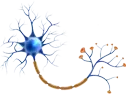
A systematic review found that fascia contains extensive innervation including nociceptors and proprioceptors, demonstrating that fascia participates in sensory perception and pain signaling.
Citation
Stecco, Carla, et al. 2022. “Fascial Innervation: A Systematic Review of the Literature.” International Journal of Molecular Sciences 23 (10): 5674. https://doi.org/10.3390/ijms23105674.
Study summary
Researchers investigating fascia’s sensory function concluded that fascia contains mechanoreceptors and nociceptors, suggesting it contributes to proprioception and pain mechanisms.
Citation
Schleip, Robert. 2003. “Fascial Plasticity: A New Neurobiological Explanation.” Journal of Bodywork and Movement Therapies 7 (1): 11–19. https://doi.org/10.1016/S1360-8592(02)00067-0.
3. Restrictions in myofascial tissue may influence sensation or proprioception.
Study summary
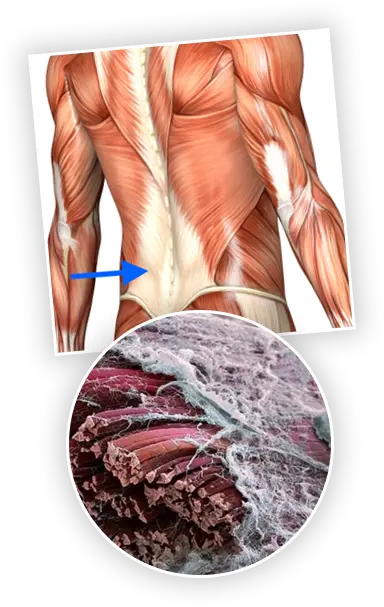
Investigators studying thoracolumbar fascia found altered shear strain and reduced mobility of fascia in chronic low back pain, which may contribute to altered proprioception and sensory function.
Citation
Langevin, Helene M., et al. 2011. “Reduced Thoracolumbar Fascia Shear Strain in Human Chronic Low Back Pain.” BMC Musculoskeletal Disorders 12:203. https://doi.org/10.1186/1471-2474-12-203.
Study summary
A review on fascia as a proprioceptive organ proposes that changes in fascial tissue structure may influence sensory feedback and body awareness, potentially contributing to musculoskeletal pain syndromes.
Citation
Stecco, Carla, et al. 2014. “The Fascia: The Forgotten Structure.” Italian Journal of Anatomy and Embryology 119 (3): 127–138.
4. Fascia and visceral organ function (indirect relationship)
Study summary
Researchers describe fascia as structurally interconnected with organs through connective tissue layers and ligaments, suggesting biomechanical relationships between fascial structures and visceral organs, though clinical evidence for dysfunction mechanisms remains limited
Citation
Findley, Thomas W., and Robert Schleip. 2007. Fascia Research: Basic Science and Implications for Conventional and Complementary Health Care. Munich: Elsevier Urban & Fischer.
Study summary
A systematic review evaluating visceral fascial therapy concluded that current clinical evidence supporting fascial treatment for visceral disorders remains limited, highlighting the need for higher-quality research.
Citation
Guillaud, Alix, et al. 2023. “Effectiveness of Visceral Fascial Therapy Targeting Visceral Dysfunctions: A Systematic Review.” BMC Complementary Medicine and Therapies 23 (1): 227. https://doi.org/10.1186/s12906-023-04099-1.
5. Myofascial restrictions are associated with pain.
Study summary
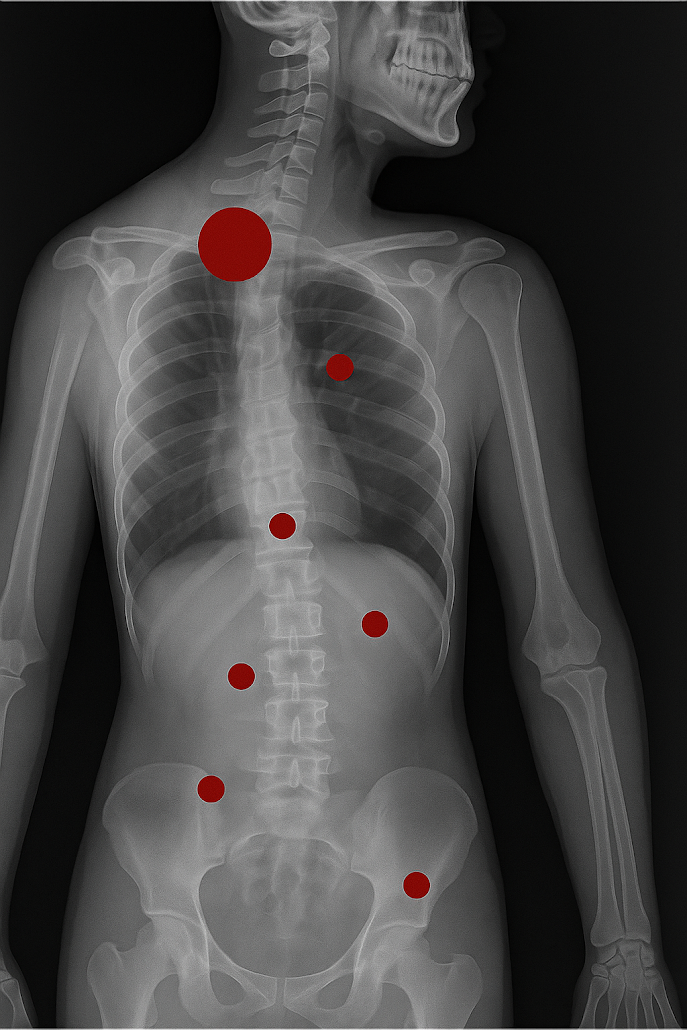
Researchers found that patients with chronic low back pain show reduced fascial mobility and structural changes in thoracolumbar fascia, suggesting fascial dysfunction may contribute to pain.
Citation
Langevin, Helene M., et al. 2011. “Reduced Thoracolumbar Fascia Shear Strain in Human Chronic Low Back Pain.” BMC Musculoskeletal Disorders 12:203. https://doi.org/10.1186/1471-2474-12-203.
Study summary
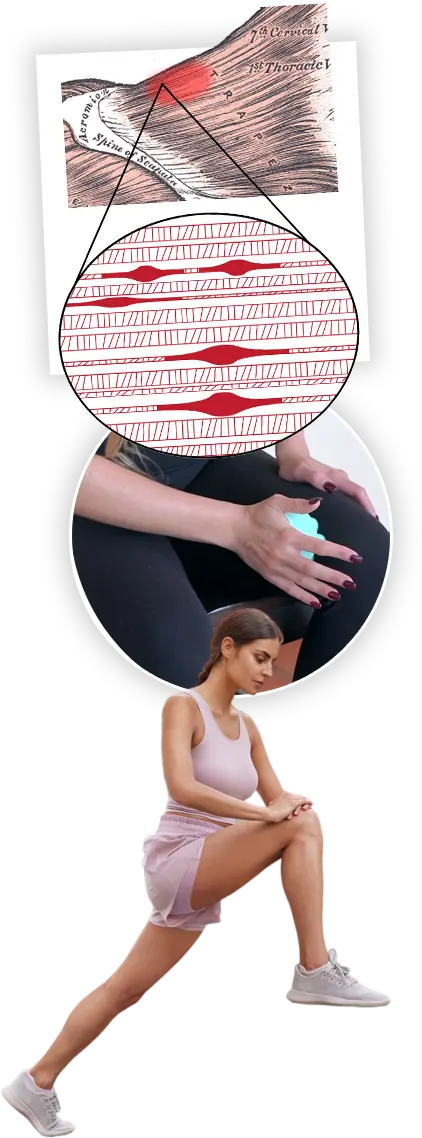
Reviews of myofascial pain syndrome identify trigger points and fascial dysfunction as common contributors to musculoskeletal pain, affecting mobility and functional performance.
Citation
Simons, David G., Janet G. Travell, and Lois S. Simons. 1999. Travell and Simons’ Myofascial Pain and Dysfunction: The Trigger Point Manual. Baltimore: Lippincott Williams & Wilkins.
6. Fascial tissue may participate in inflammatory processes.
Study summary
Experimental research demonstrates that connective tissue stretching can influence inflammatory responses, reducing inflammatory cell infiltration and promoting resolution in animal models.
Citation
Corey, Sarah M., et al. 2012. “Stretching of Connective Tissue Induces Localized Changes in Inflammation.” Journal of Cellular Physiology 227 (11): 3766–3776. https://doi.org/10.1002/jcp.24063.
Study summary
Reviews of fascia in myofascial pain suggest chronic pain states may involve inflammatory mediators and extracellular matrix remodeling within fascial tissues.
Citation
Stecco, Carla, et al. 2020. “The Fascial System in Musculoskeletal Function and Myofascial Pain.” Current Pain and Headache Reports 24 (7): 37. https://doi.org/10.1007/s11916-020-00858-2.
7. Myofascial release is an effective massage/manual therapy technique in some conditions.
Study summary
A systematic review and meta-analysis found that myofascial release therapy significantly improved pain and physical function in patients with chronic low back pain, though effects on quality of life and other outcomes were less clear.
Citation
Chen, Yu-Ting, et al. 2021. “Myofascial Release for Chronic Low Back Pain: A Systematic Review and Meta-Analysis.” Frontiers in Medicine 8:697986. https://doi.org/10.3389/fmed.2021.697986.
Study summary
A systematic review of randomized trials concluded that myofascial release may improve pain and mobility in certain musculoskeletal conditions, but evidence quality varies and further trials are needed.
Citation
Ajimsha, M. S., Binsu D’Souza, and Anoop Chithra. 2015. “Effectiveness of Myofascial Release: Systematic Review of Randomized Controlled Trials.” Journal of Bodywork and Movement Therapies 19 (1): 102–112. https://doi.org/10.1016/j.jbmt.2014.06.001.
8. Piezoelectric properties of connective tissues
Study summary
Collagen fibers exhibit piezoelectric properties, meaning mechanical deformation can generate electrical potentials that influence tissue remodeling and cellular signaling.
Citation
Fukada, Eiichi, and Isamu Yasuda. 1957. “On the Piezoelectric Effect of Bone.” Journal of the Physical Society of Japan12 (10): 1158–1162. https://doi.org/10.1143/JPSJ.12.1158.
Study summary
Modern reviews confirm that collagen-based tissues display piezoelectric behavior, contributing to mechanotransduction and tissue adaptation, particularly in bone and connective tissues.
Citation
Bassett, C. A. L., R. J. Pawluk, and R. O. Becker. 1964. “Effects of Electric Currents on Bone In Vivo.” Nature 204:652–654. https://doi.org/10.1038/204652a0.
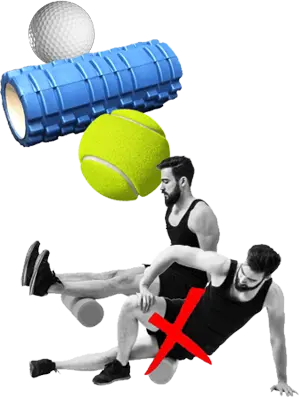
9. Foam rolling primarily produces local effects.
Study summary
A systematic review found that foam rolling reduces pain sensitivity and increases range of motion, with stronger effects observed locally at the treated tissue compared with distant regions.
Citation
Wiewelhove, Thimo, et al. 2019. “A Meta-Analysis of the Effects of Foam Rolling on Performance and Recovery.” Frontiers in Physiology 10:376. https://doi.org/10.3389/fphys.2019.00376.
Study summary
Research comparing local and distant pain responses to foam rolling found more consistent hypoalgesic effects at the treated site, supporting primarily local mechanisms.
Citation
Nakamura, Masatoshi, et al. 2021. “Local and Non-Local Effects of Foam Rolling on Passive Soft Tissue Properties and Spinal Excitability.” Frontiers in Physiology 12:702042. https://doi.org/10.3389/fphys.2021.702042.
10. Mobility and range of motion influence muscle growth and performance.
Study summary
A systematic review concluded that training through greater ranges of motion can enhance muscle hypertrophy and strength adaptations, compared with restricted ranges.
Citation
Schoenfeld, Brad J., and Jozo Grgic. 2020. “Effects of Range of Motion on Muscle Development During Resistance Training Interventions.” Journal of Strength and Conditioning Research 34 (7): 1–11. https://doi.org/10.1519/JSC.0000000000003727.
Study summary
Reviews of resistance training adaptations indicate that limited flexibility or joint range of motion can affect exercise mechanics and muscle development, influencing training outcomes.
Citation
Pinto, Rodrigo S., et al. 2012. “Effect of Range of Motion on Muscle Strength and Thickness.” Journal of Strength and Conditioning Research 26 (8): 2140–2145. https://doi.org/10.1519/JSC.0b013e31823a3b15.